




“A compelling and insightful portrait of one of the Caribbean’s most consequential leaders.”
— Publisher
“Excellent, well-researched, calm, even-handed, well-written, very informative.”
—Dr. Jolien Harmsen, author of A History of St. Lucia
“A great read, very informative and engaging.”
—Dr. Prosper Raynold, Professor Emeritus of Economics
“A sweeping biography … an impressive record of vision, political acumen… “
—John Robert Lee, author of After Poems, Psalms
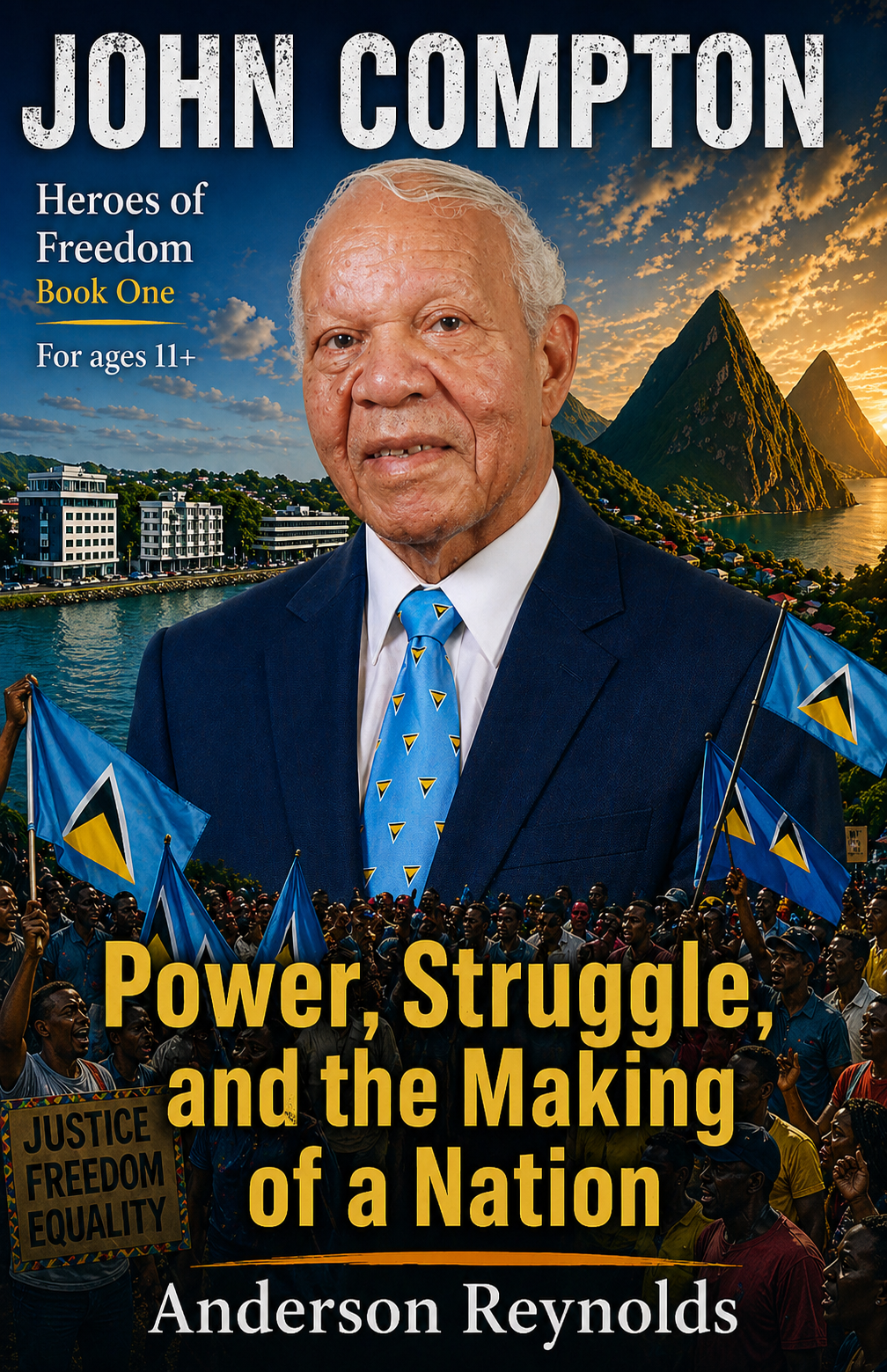
Few leaders had as profound an influence on St. Lucia as John Compton. For more than forty years, he stood at the center of the island’s political life, guiding the country through the final years of colonial rule, leading it to independence, and returning to power again and again during moments of crisis and change.
Brilliant, determined, and often controversial, Compton inspired fierce loyalty among supporters and strong opposition from critics. He faced economic upheavals, political rivalries, strikes, and shifting global forces that threatened the stability of the young nation.
This engaging biography tells the story of the boy from the tiny, windswept island of Canouan, who became the dominant architect of modern Saint Lucia, his adopted home. Through triumphs, setbacks, and dramatic turning points, it explores the leadership, ambition, and resilience that defined one of the Caribbean’s most influential statesmen.
A powerful story of courage, nation-building, political struggle, and Caribbean leadership.
Reviews of John Compton: Power, Struggle, and the Making of a Nation
Modeste Downes, author of A Lesson on Wings
Although differing from them in that most were militaristic and expansionist, this hero is linked by the common trait that they were all nation builders and monumental in their accomplishments.
Upon reading this enchanting biography on the life of one of the Caribbean’s most notable leaders, anyone who has had only an introduction to the history of civilization will have recalled some of the great figures down the ages who, in distinctive ways, helped to shape their part of the world, leaving indelible footprints behind. Images of Julius Caesar, the Pharaohs, Alexander the Great, Imhotep, among others, crept into my mind.
The author, Dr. Anderson Reynolds, tends to tackle material seemingly anathema to his peers—with the exception, perhaps, of Rick Wayne and McDonald Dixon. This daring, detailed and delectable treatment of the life and times of John Compton is no exception.
In John Compton: Power, Struggle and the Making of a Nation, armed with all the information he could possibly assemble, Reynolds flexes his creative muscles and what emerges is a true and near-complete picture of a man destined for leadership and poised to accomplish big things.
The narrative he weaves is of a character who springs from insignificance and, in lightning time, assumes political leadership of a country where he was not born, reconstructs the political modus operandi, and changes the face and prospects of the island of Saint Lucia by leaps and bounds.
In John Compton (Heroes of Freedom, Book One), we encounter the three-dimensional character of the man who wrests Saint Lucia from the apron strings of British colonial rule, into self-governance and independence, and sets the pace for economic development, industrial growth, and modernization.
At the center of this fast-paced narrative are John Compton the man, John Compton the politician, and John Compton the nation builder.
Local lore has it that John Compton was a shy man who had “a habit of not looking others in the eye”, an idiosyncrasy some regarded as weakness. (pg. 61). His wife remembers “being put off by what seemed to be his rude and abrupt manner” during their courtship. (pg. 132). It turns out that these were marks of a man of few words, whose actions spoke louder than volumes of words.
The Compton presented in this book reveals a man given to the simple things of life; a man who loved the sea and sailing—something planted in his DNA; a very hands-on man, a devoted farmer whose Mahaut estate was a place of refuge—for relaxation and cogitation. Above all, he was a devoted, caring family man, whose “greatest wish was not fame or recognition, but to be a devoted husband and father, living as a farmer.” (Ch. 12).
Besides, Compton comes across as a visionary who saw beyond the immediate solution to planks on which bigger outcomes were earmarked.
As a politician, John Compton’s involvement was marked by uncompromising determination and a clear vision: to free his country from the stranglehold of British colonialism. The conditions he witnessed upon arrival in Castries in 1939 and while growing up there; his brief working stint in Curacao; and his sojourn in England as a university student had all prepared him for this. And he pursued it with a passion.
Compton, the politician, was bold, strategic, focused, and self-willed. To wit: consider his 1957 gun-toting showdown with Denis Bernard, sugar factory owner, in support of striking workers. (Ch. 4).
It is the strategist and tactician who forged links with other politicians and the opposition, leading to the formation of his United Workers Party in 1964, that finished off George Charles and his team. (Ch. 5).
And though he admits he didn’t achieve things alone, it is clear that Compton was the architect of ideas, and once he set his mind on something, there was no turning back.
When he assumed the reins of power, Compton was hell-bent on shifting gears, on changing the living and working circumstances of the people. He saw the colonial administration as uncaring and a stumbling block to be dispensed with. In chapter after chapter, Reynolds demonstrates how Compton worked to rid the population of bilharzia, poor housing, low wages, illiteracy, and a shortage of schools, while contending with criticism, limited resources, and political opposition.
On his way to self-governance and full independence, the engineer in John Compton is frequently called upon, as evidenced by the major infrastructural projects that form part of his modernization campaign.
Of course, some criticized him as having “tunnel vision,” but it is the visionary in him that has made Saint Lucia the beneficiary of an impressive catalog of initiatives serving as planks for social, educational, economic, and human development, making the island the lead OECS state, and the envy of others in CARICOM.
One thing that must be said, finally, is that Compton was a profound regionalist and completely dedicated to the integration movement. He would have lamented the break-up of the West Indies Federation, and much credit must be given to him for the formation and success of the OECS.
The author intends this text particularly for young readers. However, I’m convinced the book is well-suited to an adult readership in any jurisdiction.
John Robert Lee, author of After Poems, Psalms
No one could seriously deny the honorific title of “Father of the nation” to Saint Lucia’s first and former Prime Minister John Compton (1925-2007). From his elected entry into Saint Lucian politics in 1954 to his death in office in 2007 as Prime Minister, he led the most consequential social changes on the island. He took Saint Lucia from a relatively poor sugar estate under British colonial rule to a modern, prosperous Caribbean nation. That transition was not without many and huge challenges, and periods of unpopularity. The Caribbean itself was moving from colonial dependency to independence, with a growing consciousness of new generations of their place in a racist, oppressive superpower world full of prejudices and many kinds of exploitation. But Compton, through social and educational improvements, led his people to confidence in their abilities and capabilities. For over thirty years, his United Workers Party government was unbeatable at the polls. That he returned at 80 to win an election by a huge majority is testament to his charisma and leadership.
Saint Lucian writer Anderson Reynolds has recently published his latest book titled “John Compton: Power, Struggle and the Making of a Nation”. It seems to be part of a series, “Heroes of Freedom,” Book One – for ages 11 and older. A good, comprehensive overall setting out of the political career and achievements of Sir John Compton. Good for younger readers, but also will be appreciated by older readers who will be reminded of how Compton and his governments led Saint Lucia out of crown colony government, its poverty, few educational, economic, and other opportunities, its control by a few business and other plantation interests—into a modern, developed Caribbean independent nation.
Compton was a colorful politician, modest in many ways, whose achievements are real and have contributed to present social and economic life. Dr. Reynolds’ new book is recommended, and a very useful new historical record of the man many recognised as the Father of the nation.
It is a sweeping biography, from Compton’s early life on Canouan, Saint Vincent and the Grenadines, his early education in Saint Lucia at St. Mary’s College, then his travels to Curacao to work. In 1948, he traveled to London to study law at the London School of Economics and returned to Saint Lucia by 1951.
With adult suffrage, Saint Lucia’s first general election was held in October 1951. The Saint Lucia Labour Party led by George Charles won that election. In 1954, Compton ran as an independent for the Dennery/Micoud seat and won. In 1957, major sugar strikes with serious confrontations between sugar workers and factory owners brought Compton to the forefront as a popular defender of workers’ rights. In 1964, Compton formed and led the new United Workers Party to victory in elections. The Compton era begins, and for over forty years until his death in office as Prime Minister in 2007, he was the most influential leader of the country. The Labour Party did return to government for periods during those years, but Compton was the undisputed influential leader of his time.
Reynolds sets out in this book the major achievements of Compton and his governments. It is an impressive record of vision, political acumen, and a sense of how small Caribbean nations should develop in the mid-twentieth century. He took the economy from dependence on sugar to profitable bananas to tourism. He made major improvements in the provision of educational opportunities, both through school construction and through scholarships. Electricity, water, social security, health, infrastructure, especially in roads and major highways, housing, hotel and touristic facilities, and foreign affairs all owed their developments to his vision and governmental leadership.
In 1979, he led Saint Lucia to independence and became the first Prime Minister. His long tenure was blessed with the international award of two Nobel Prizes—Sir Arthur Lewis for Economics in 1979 and Sir Derek Walcott for Literature in 1992. Men whom he knew well and had inspired him. Under Compton, the late sixties and seventies had seen a revival and renaissance of Saint Lucia’s arts and culture. He was an enthusiastic supporter of folk and other artists.
He retired as UWP leader in 1996, but returned in 2005 at 80 as leader of the party he had founded. Amazingly, he won a landslide victory in 2006, but then died in 2007 at 82.
No one, not even his political adversaries, would reserve their admiration for this master politician and respected Caribbean leader. He was involved in the formation of the regional bodies CARICOM and the OECS. His political conservatism was based on a realistic view of the place of small nations in an aggressive, more powerful world. He sought to find a way in between the “sharks” for the smaller “fish” of islands like Saint Lucia to survive.
Anderson Reynolds is a prolific Saint Lucian author. Among his several publications are other works on major Saint Lucian political figures, biographies of his father and mother and novels. This latest work is well written and a timely record of the significant achievements of Sir John Compton, Father of the Nation, the first Prime Minister.
Travis Weekes, author of Take Me To Mon Repos
Once I started reading the biography, John Compton: Power, Struggle and the Making of a Nation, by Dr. Anderson Reynolds, I had to remain with it until the end. I am aware that I am repeating a cliché, but I choose to start this review with a truth that strikes instantly.
John Compton is an interesting story. Here, I refer to the man, but the story of John Compton is synonymous with the story of the development of post-colonial Saint Lucia. Dr. Reynolds sticks to the form of conventional biography and follows the chronological development of this outstanding figure, thereby facilitating easy read through the history of Saint Lucia from the 1950s up to the millennium. This is a crucial period leading to the birth of the nation.
The chronological tale is one approach that makes Dr. Reynolds’s book smooth and easy reading. He traces Compton’s humble beginnings from the tiny island of Canouan where he was born, then takes us along the journey to his migration to Saint Lucia, where he received a secondary education at the island’s top educational institution at the time, the famous Saint Mary’s College. Dr. Reynolds continues the narrative of Compton’s journey to Curacao and his subsequent pursuit of higher education in the United Kingdom before returning to Saint Lucia, where he plunged almost immediately into the workers’ struggle and elective politics. We can tell from the start that we are going to follow the journey of a small island boy who would become an exceptional figure of his time.
Dr. Reynold’s biography of John Compton is also an easy read, as it appears he is deliberately targeting the average reader. While it is true that an academic will find the chronological narrative of significant events in Saint Lucia’s social and political history immensely valuable, the book does not employ the heavy academic jargon that would constantly send the reader to Google to unpack meaning.
The language is everyday; it reads like the storytelling of an old friend whose mentor has died and who wishes the world to receive an account from the family and its inner circle. This is also what makes the book super interesting. Although Dr. Reynolds does not shy away from throwing in the voices critical of Compton, his objective is to plot the map of the hero’s trajectory, to tell where he was going and have the reader follow his vision for the development of Saint Lucia.
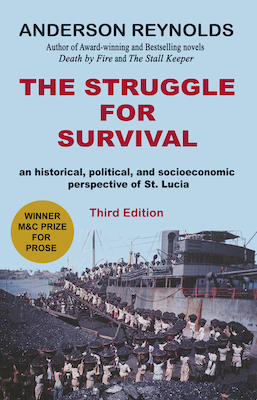
One should not let my comments on the simplicity of Dr. Reynold’s writing suggest in any way a flippancy regarding the chronicling of historical events. His earlier publications such as The Struggle for Survival, Saint Lucia at a Crossroads and They Called Him Brother George, all reflect his passion for research into Saint Lucia’s social and political history. Indeed, this latest publication is quite detailed in its anchoring of the major local, regional and global events that posed mammoth challenges for the life and politics of John Compton. The Sugar Cane unrests of the 1950s, the Independence controversies of the late 1970s, the Banana riots of the 1990s; Dr. Reynolds goes into the bellies of all these socio-political monsters and turns them out to expose the horrific challenges that Compton faced and endured as leader.
Thus, Dr. Reynolds’ own training as an academic is evident. This biography is quite structured. Paragraphs and subtitles organize the entire text and carefully guide the reader. This aspect of the text should prove very useful for teachers in our secondary schools, as they can organize lessons and point students to epochs of Saint Lucia’s social or political history that they wish to bring into focus, one period at a time. This book should certainly make the list of CXC recommended texts in the fields of History and Social Studies.
John Compton: Power, Struggle and the Making of a Nation, by Dr. Anderson Reynolds, is a long-awaited book. It should be mandatory reading for all Saint Lucians aged 15 and over and for all readers interested in the Caribbean’s social and political history.